
To establish connectivity between the IPPBX(A) and IPPBX(B), we need to establish a connection between the two systems. This will allow extensions in both directions to communicate with each other.
IPPBX
Model: FCM630A
Extensions Range from 1000 to 1009
Ip: 192.168.0.101
IPPBX
Model: FCM5404
Extensions Range from 2000 to 2009
Ip: 192.168.0.102
TOPOLOGY

ON FCM630A #
Create SIP Trunk on FCM630A #
– Login to FCM630A Web GUI
Access the FCM630A interface through your browser to configure PBX settings.
– Navigate to Extensions/Trunks → VOIP Trunks
Open the section where all existing VoIP/SIP trunks are listed and managed.
– Click “Add SIP Trunk” to configure a new trunk
Start creating a new peer SIP trunk to connect with another PBX or remote system.

Establish a Peer SIP Trunk Between FCM630A and FCM5404
– Trunk Type: Peer SIP Trunk
Ensure the trunk type is set to “Register SIP Trunk” to allow registration with the peer PBX.
– Trunk Name: FCM5404
Enter a clear name to identify this SIP trunk between FCM630A and FCM5404.
– Host Name
Enter the IP address and port of FCM5404 (e.g., 192.168.0.102:5080) to define the destination for the SIP trunk.

– Press “Save” and then “Edit.”
Save the initial trunk configuration and reopen it for further advanced settings.
– Navigate to Advanced Settings
Open the section containing additional trunk options.
– Enable Heartbeat Detection
Check the box for Enable Heartbeat Detection to continuously monitor the trunk status and ensure the connection with the peer PBX is active.

– To know the status of the trunk in FCM5404, navigate to System Status → Dashboard
Access the Dashboard to check the current status of all trunks, including registration state, connectivity, and any errors.

A new trunk has been configured
On FCM5404 #
Create SIP Trunk on FCM5404 #
– Navigate to Extension/Trunk → VoIP Trunks
Open the VoIP Trunks section to create and manage SIP trunk connections.
– Click “Add SIP Trunk”
Start configuring a new SIP trunk.
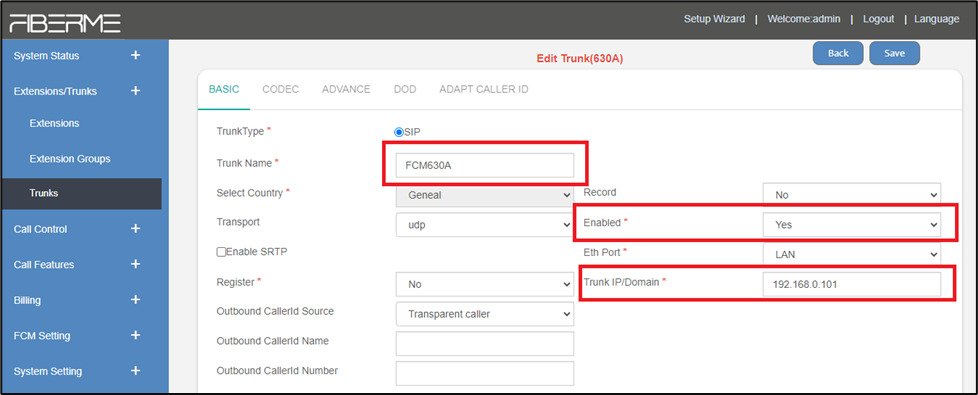
– Trunk Name: FCM630A
Enter a clear name for the trunk, for example FCM630A, to identify the remote PBX.
– Type: SIP
Set the trunk type to SIP to establish a peer SIP trunk between FCM630A and FCM5404.
– Trunk IP/Domain: 192.168.0.101
Enter the IP address of FCM630A, which is 192.168.0.101 in this scenario.
– Register: No
Make sure the Register field is set to No. This means the trunk will connect directly using the peer IP address without SIP registration.
– Navigate to Advanced
Open the advanced configuration section of the SIP trunk.
– Set OPTIONS Interval: 15
Enter 15 seconds to define how often the trunk sends SIP OPTIONS messages for monitoring the peer PBX status.
– Click “Save”
Save the advanced settings to apply the configuration.

A new trunk has been configured
CALL ROUTING ON FCM630A #
Configure Outbound Routes on FCM630A #
– Navigate to Extension/Trunk → Outbound Routes
Open the Outbound Routes section to create a new outbound calling rule.
– Click “Add”
Start creating a new outbound route.
– Route Name: To FCM5404
Enter a clear name for the route to identify calls going to FCM5404.
– Pattern: 200x
Set the dial pattern to match extensions 2000–2009.
– From “Privilege Level”
Select the privilege level assigned to the extensions allowed to use this route.
– From “Main Trunk”
Select trunk FCM5404 as the outbound path for this route.
– Click “Save”
Save the outbound route configuration.
– Click “Apply Changes”
Apply the changes to activate the route for all eligible extensions.


A new route has been configured.
Configure Inbound Routes on FCM630A #
– Navigate to Extension/Trunk → Inbound Control
Open the inbound routing section to manage incoming calls.
– Choose the SIP Trunk FCM5404 and click “Add”
Select the trunk that will handle inbound calls from FCM5404 and add it to the inbound route configuration.

– Name: IN_FCM5404
Assign a clear name to identify the inbound route from FCM5404 via FRC.
– Pattern: 200x
Define the dial pattern that matches the extensions receiving calls from the peer PBX.
– Destination: By DID
Route incoming calls using Direct Inward Dialing (DID).
– Allowed DID Destination: Extension
Specify which internal extension(s) are allowed to receive these incoming calls.


A new route has been configured.
Call Routing on FCM5404 #
Configure Outbound Routes on FCM5404 #
– Navigate to Call Control → Outbound Routes
Open the Outbound Routes section in the FCM5404 web GUI to create a new route.
– Delete the default route
Remove the existing default route to avoid conflicts with the new outbound routing configuration.

– Click “Add”
Start creating a new outbound route.
– Name: Any name
Enter a name to identify the outbound route clearly.
– Dial Plan: Pattern 100[0-9]
Set the dial pattern so that the dialed number must be 4 digits, and the last digit ranges from 0 to 9.
(For more details on dial patterns, refer to the system’s dial plan guide.)
– Member Extensions
Select the extensions that are allowed to use this outbound route.
– Member Trunks
Choose the trunks that will be used for this route; in this scenario, it will be the previously configured Peer SIP trunk.


A new route has been configured.
Configure Inbound Routes on FCM5404 #
– Navigate to Call Control → Inbound Routes
Open the Inbound Routes section in the FCM5404 web GUI to create a new route.
– Delete the default route
Remove the existing default route to prevent conflicts with the new inbound routing configuration.

– Click on “Add” to configure a new route.

– Name
Assign a name to identify the inbound route, for example: From_FCM5404.
– DID Pattern
Enter the DID number forwarded from FCM630A to the SIP Peer Trunk on FCM5404.
The DID pattern must match the extension range in the number of digits configured.
– Destination
Select where the incoming calls will be directed. Multiple destinations are possible depending on your setup (e.g., extensions, queues, IVR).
– Member Trunks
Choose the trunk that serves as the source for this route, in this scenario, it will be the previously configured SIP Peer Trunk.

A new route has been configured.