
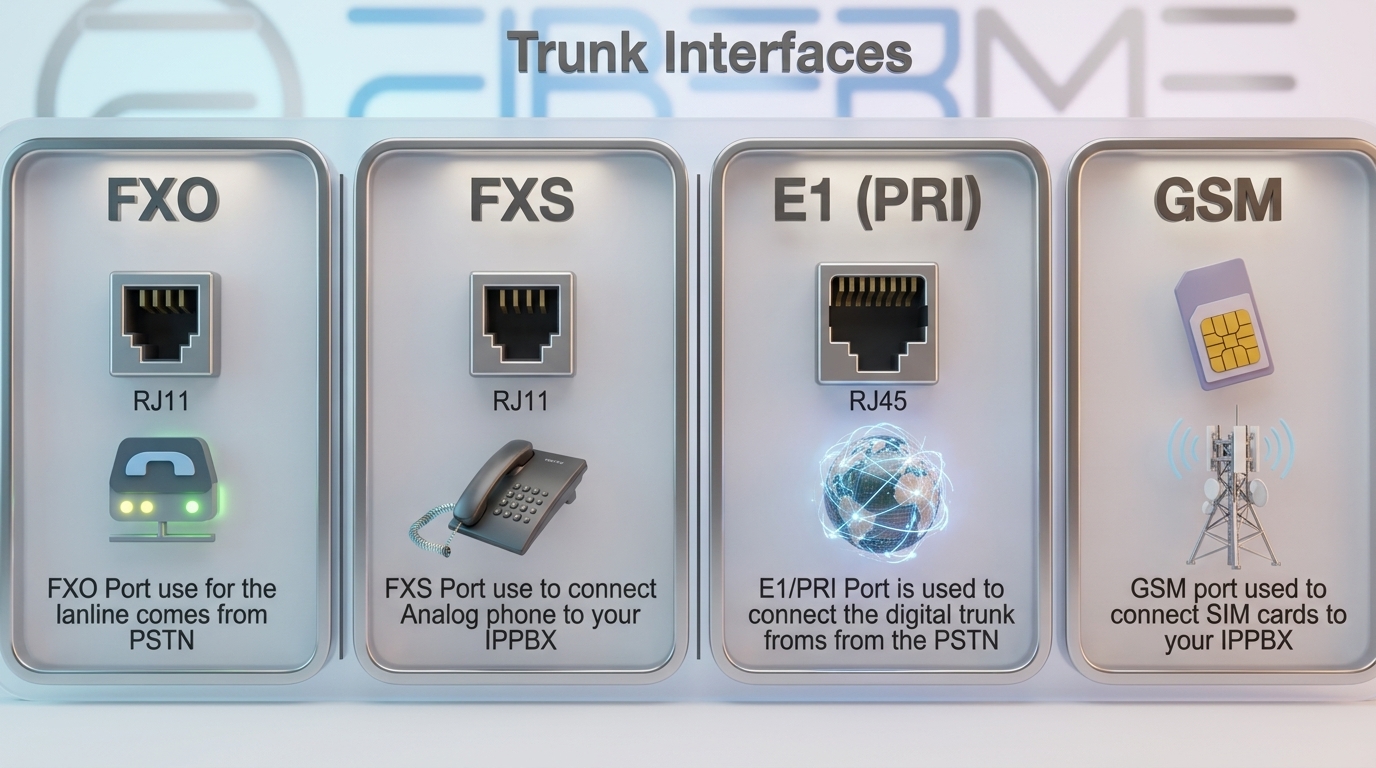
This section explains the name and function of each interface and port used in the IP PBX system.
FXO Port:
The FXO port is used to connect analog PSTN landlines to your IP PBX system. If your IP PBX does not have built-in FXO ports, you will need to use an FXO gateway. This allows the system to receive and make calls through traditional PSTN lines.
Each Lanline requires 1 FXO Port.
FXS Port:
FXS ports are used to connect analog devices such as traditional telephones. While SIP extensions can be used with IP phones or softphones, FXS ports are required when connecting older analog phones. If the IP PBX does not include built-in FXS ports, an FXS gateway can be added to support these devices.
Each analog phone requires 1 FXS Port.
E1/PRI:
In addition to analog lines, PSTN providers offer digital E1/PRI lines. An E1 line can support up to 30 simultaneous voice channels. To connect an E1/PRI line to your IP PBX, an E1 port is required. If your system does not have this port, an external E1 gateway must be used.
Each E1/PRI Digital line requires 1 E1 Port.
GSM:
GSM ports are used to connect SIM cards to the IP PBX, enabling calls over mobile networks. If your IP PBX does not have built-in GSM ports, a GSM gateway can be added to provide this functionality.
Each SIM Card requires 1 GSM Port.