
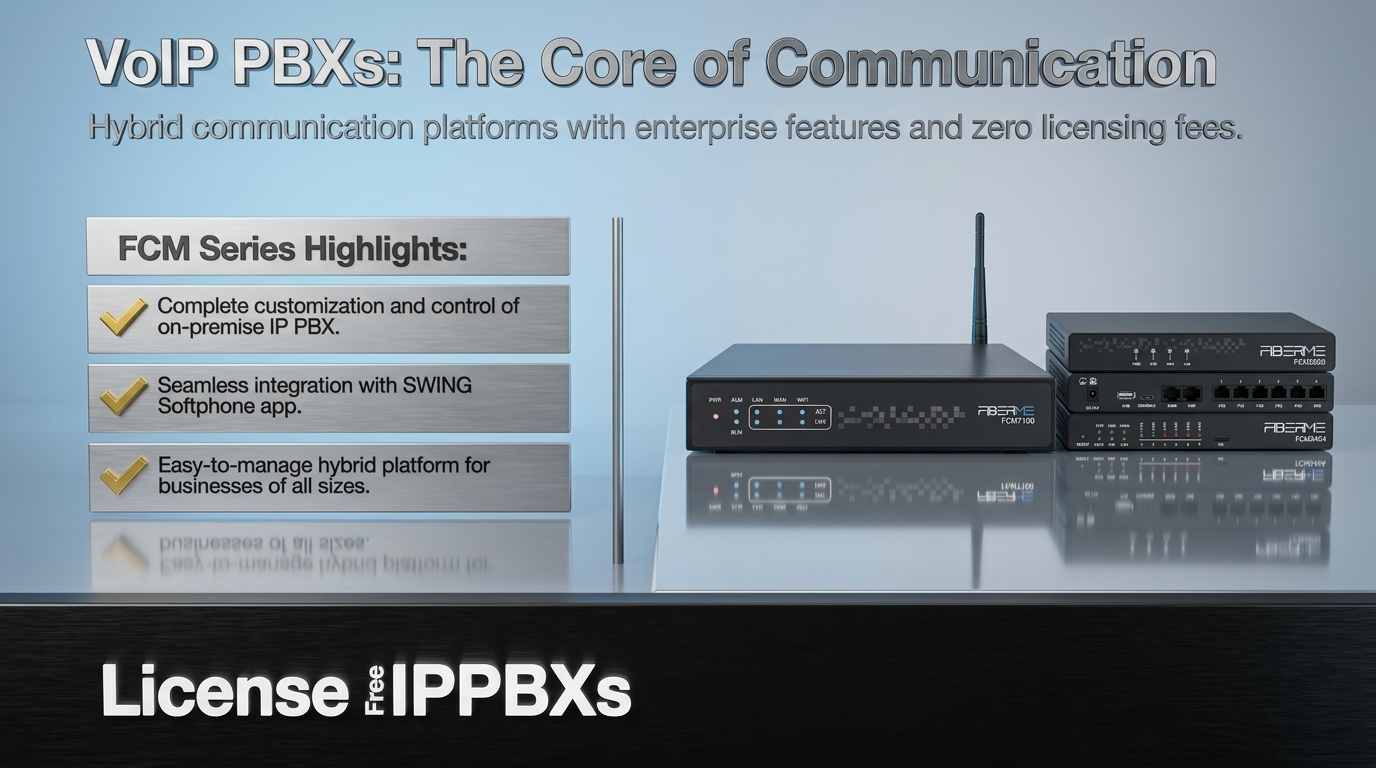
Introduction to FIBERME VoIP PBX Hardware
1.1 Overview of FIBERME PBX Solutions
FIBERME provides a comprehensive range of VoIP PBX hardware devices, each equipped with embedded FIBERME PBX software.
These integrated solutions are designed to deliver enterprise-grade communication capabilities without requiring additional software installations.
The FIBERME IP-PBX product line is built around the FCM series, where “FCM” stands for FIBERME Call Manager.
All FCM models are purpose-built to support scalable IP-based telephony environments for businesses of varying sizes.
1.2 Capacity and Scalability
FIBERME PBX hardware supports systems ranging from:
-
Minimum: 60 users/extensions
-
Maximum: up to 1,500 users/extensions
This wide capacity range allows organizations to:
-
Start with a small deployment and grow over time
-
Choose a model that matches their current and future communication needs
-
Avoid premature hardware upgrades by selecting a system with sufficient scalability from the outset
1.3 Analog Port Configuration
A key distinction among FIBERME IP-PBX models is the presence (or absence) of analog ports:
-
Standard FCM Models:
-
Do not include analog ports (neither FXO nor FXS)
-
-
Special Model – FCM5404:
-
Includes built-in 4 FXO ports (for connecting analog PSTN lines)
-
Includes built-in 2 FXS ports (for connecting analog phones or other analog devices)
-
This makes the FCM5404 ideal for organizations that:
-
Still rely on legacy analog lines or devices
-
Need a hybrid environment (IP + analog) without adding external gateways
-
Want a single-box solution for both digital and analog integration
1.4 Common Features Across All FIBERME IP-PBX Models
All FIBERME IP-PBX devices include a core set of standard features, ensuring consistent functionality across the product line:
-
SIP Extensions: Support for IP-based endpoints (phones, softphones, mobile apps)
-
Voicemail: Personal and system-wide mailbox with notification options
-
SIP Trunking: Connection to SIP-based service providers and carriers
-
Call Forward: Forward calls to other internal or external destinations
-
Call Follow-Me: Ring multiple destinations in sequence or simultaneously
-
Ring Group: Distribute incoming calls to a group of users
-
Paging and Intercom: One-to-many announcements and internal communication
-
IVR (Interactive Voice Response): Automated call routing using voice or keypad input
-
Call Queue: Manage and distribute high-volume incoming calls with queue logic
-
Call Reporting: Generate statistics and reports on call activity
-
Call Recording: Record inbound and outbound calls for compliance and quality
-
Call Monitoring: Supervise live calls for supervision and training
-
Call Back: Allow callers to request a callback when a line becomes available
-
DISA (Direct Inward System Access): Enable external users to dial into the system and place outbound calls
-
Backup and Restore: Backup system configuration and restore it when needed
These features form the foundation of modern business telephony and are available on every FCM model.
1.5 Additional Features in Specific Models
Beyond the common feature set, some FIBERME IP-PBX models offer enhanced capabilities focused on:
-
More detailed call metrics and analytics
-
Advanced reporting and statistics
-
Extended monitoring and supervision tools
-
And more…
These model-specific enhancements will be explored in detail during later sections of the course, where you will:
-
Compare different FCM models based on feature sets
-
Understand which model best fits specific business scenarios
-
Learn how to configure and leverage advanced features in practice